
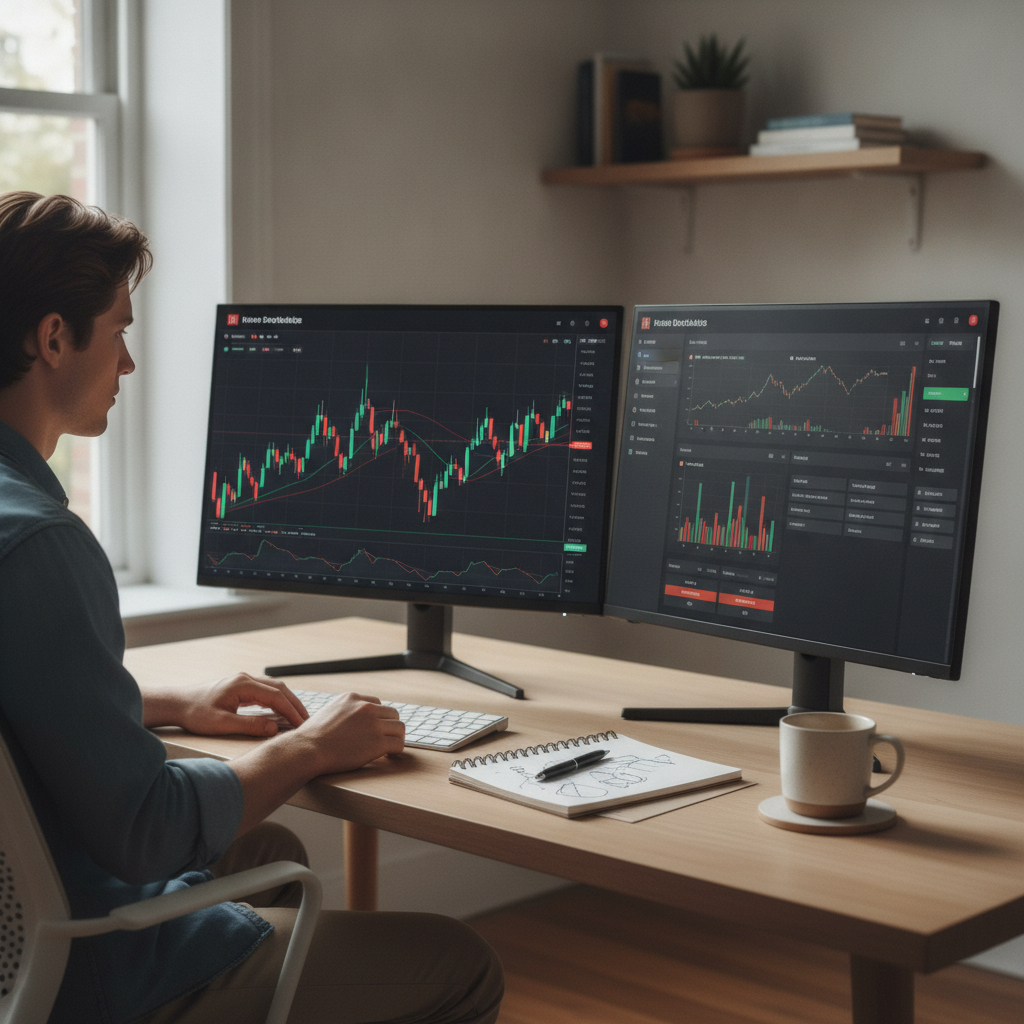
Stock trading courses for beginners are structured learning programs that teach core market basics, risk rules, and execution skills in a practical sequence. A focused starter course covers order types, chart reading, and discipline within 4–8 weeks for learners in India and worldwide. This foundation reduces costly mistakes, speeds learning, and builds confidence.
By Proxima Learning • Last updated: 2026-06-24
Your First Steps Into Trading
Start with a structured path that teaches market basics, risk control, and execution. Build a routine, journal every trade, and focus on one or two high-probability setups. For new traders, consistency and risk discipline matter more than quick wins or complex indicators.
You don’t need a finance degree to trade well. You need a clear plan, disciplined risk, and guided practice. In this complete guide from Proxima Learning, you’ll learn how to pick the right beginner path, avoid common traps, and use education, signals, and advisory support to accelerate progress—without skipping fundamentals.
Table of Contents
- Overview
- What Is a Beginner Stock Trading Course?
- Why Beginner Courses Matter
- How These Courses Work
- Types of Courses and Learning Paths
- Best Practices for Beginners
- Tools, Signals, and Advisory Resources
- Case Studies and Real Examples
- Frequently Asked Questions
- Conclusion, Key Takeaways, and Next Steps
Overview
A strong beginner course simplifies complex concepts and gives you rules you can act on. Expect short lessons, live practice, trade journaling, and measurable goals over 4–8 weeks. The outcome is repeatable execution and a personal playbook built on risk-first discipline.
Proxima Learning is a unified education and advisory platform designed for retail traders who value clarity and structure. We combine expert-led courses, live sessions, and real-time trading signals with portfolio advisory and research. That blend helps beginners build confidence faster while learning the habits that fuel long-term consistency.
What Is a Beginner Stock Trading Course?
It’s a step-by-step curriculum that teaches market basics, order types, chart reading, risk management, and trading psychology. The best programs connect theory to live markets with practice tasks, quizzes, and reviews so you can move from knowledge to confident execution.
In our experience, starter programs work best when they sequence topics in a way that cuts confusion. You’ll cover price action, support/resistance, trend structure, candlesticks, and risk controls like capping any single trade to 0.5–1.0% of account risk. A good baseline is to log 30–50 practice trades in a journal and evaluate entries, exits, and compliance with your rules.
- Core concepts: price action, trend, support/resistance, volume.
- Mechanics: order types, time-in-force, slippage, partial exits.
- Risk: position sizing, stop placement, daily loss limits.
- Psychology: patience, bias checks, emotional resets.
- Review loop: tag setups, calculate R-multiples, adjust one rule at a time.
Here’s the thing: the market rewards process more than prediction. A stock trading course for beginners should give you a process you can follow under pressure—checklists, risk math, and if-then rules that steady your hands when screens move fast.
Why Beginner Courses Matter
Beginner courses compress years of trial-and-error into weeks. You follow a proven path, use rules that manage downside, and get mentorship that keeps you from self-sabotage. That’s how you build consistency and confidence early.
Most new traders bounce between indicators and social media tips. A structured plan forces focus: one or two high-probability setups, a 1:2 or better risk-to-reward, and a daily routine (15–30 minutes of prep). With accountability and evidence-based reviews, your win rate stabilizes near your true edge instead of luck.
- Faster clarity: short, sequenced lessons remove jargon and guesswork.
- Downside control: fixed risk per trade (0.5–1.0%) contains drawdowns.
- Habits that stick: journaling and weekly reviews hard-wire discipline.
- Confidence building: practice reps (30–50 trades) normalize variance.
- Guided acceleration: optional signals and advisory reduce overthinking.
We’ve found that beginners who journal at least 30 sample trades within six weeks understand variance and stop chasing noise. They start respecting stops, holding winners to targets, and focusing on execution quality—not just P&L.
How Beginner Courses Work
Great courses blend modular lessons, live sessions, and guided practice. You’ll study concepts, watch them applied in real markets, and execute with clear entry, target, and stop rules. Feedback loops—reviews, signals, and advisory—reinforce good habits.
Expect a weekly cadence that’s realistic for busy schedules. Two to three micro-lessons, one live Q&A, practice tasks, and a trade-review checkpoint build momentum without overwhelm. A solid baseline is to codify 3–5 setups, risk 0.5–1.0% per trade, and complete 30–60 days of practice with at least 30 journaled trades.
- Learning blocks (20–30 minutes): market structure, entries, exits.
- Live reinforcement: see examples during market hours or in replays.
- Practice reps: simulator or small size to build pattern recognition.
- Review & refine: tag, score, and adjust one rule at a time.

At Proxima Learning, we pair expert-led lessons with live sessions and optional real-time trading signals. Those signals include predefined entry, target, and stop-loss levels so you can learn how a disciplined plan looks before building your own. When you’re ready, our portfolio advisory helps align your trading education with long-term investing goals.
Types of Courses and Learning Paths
Self-paced lessons offer flexibility, live cohorts add accountability, mentor-led paths deliver personalized feedback, and blended tracks combine all three. Pick the mode that fits your schedule and learning style to stay consistent.
Choosing a path that matches your personality matters as much as the curriculum. Some traders value the freedom to rewatch lessons; others thrive with deadlines and feedback. Many beginners do best with a blended path: on-demand core lessons, weekly live workshops, and guided practice sessions.
Common Paths
- Self-paced: watch short videos and complete checklists at your speed.
- Live cohort: attend weekly workshops and get peer accountability.
- Mentor-led: receive 1:1 critiques and tailored playbook guidance.
- Blended: mix on-demand lessons with live Q&A and practice drills.
Course Type Comparison
| Course Type | Best For | Accountability | Time Demand | Key Benefit |
|---|---|---|---|---|
| Self-paced | Busy schedules | Low | Flexible | Replay lessons anytime |
| Live cohort | Structure seekers | Medium–High | Weekly | Deadlines + practice |
| Mentor-led | Targeted feedback | High | Weekly/biweekly | Personalized playbook |
| Blended | Most beginners | High | Weekly | Structure + flexibility |
In our programs, a typical beginner track involves 60–90 minutes of core videos weekly, one live Q&A, and two practice windows. Over 30–60 days, you’ll codify 1–2 setups and complete at least 30 trades to quantify your edge before scaling size.
Best Practices for Beginners
Standardize your routine: pre-market scan, confirm trend and levels, define risk, set alerts, then journal outcomes. Checklists convert nerves into process and keep execution consistent when screens move fast.
Pre-Trade Checklist
- Context: market trend, sector strength, catalyst check.
- Levels: support/resistance, premarket highs/lows, moving averages.
- Risk: size to 0.5–1.0% risk; define stop distance and target.
- Plan: entry trigger, order type, partials, invalidation rule.
- Alerts: notifications at trigger/target; avoid screen-chasing.
Post-Trade Review
- Score execution (A–F) on plan adherence, not P&L.
- Tag setups and conditions for pattern recognition.
- Update metrics: win rate, average R, consecutive losses.
- Refine one rule at a time based on evidence.
Common Mistakes to Avoid
- Switching strategies before logging 30–50 trades.
- Ignoring a -2R daily stop after two planned losses.
- Confusing headlines for signals or abandoning targets.
- Oversizing outside your 0.5–1.0% risk rule.
Great traders rely on boring routines. If you do the same simple things well—every day—you’ll likely outperform traders who keep changing the plan. Discipline compounds.
Tools, Signals, and Advisory Resources
Use a reliable charting platform, a broker with stable execution, a journal that tracks R-multiples, and curated education. Add real-time stock signals and long-term portfolio advisory when you’re ready for guided acceleration.
At Proxima Learning, education isn’t isolated from real markets. We provide real-time trading signals and alerts with predefined entry, target, and stop-loss levels, plus live sessions that show how plans are built. When you want a longer horizon, our portfolio advisory aligns your investments with diversification, risk tolerance, and periodic reviews.
- Charting: moving averages, volume, trendlines, alerts.
- Scanning: gap/range breaks, high relative volume.
- Journaling: R-multiples, execution score, mistake tags.
- Signals: time-stamped entries, targets, stops to model discipline.
- Advisory: long-term planning, diversification, review cadence.

We also publish market research and reports to help you find high-potential setups. When you see how a clear plan looks—entries, targets, and predefined stops—you learn to separate a disciplined signal from a distracting headline. Over time, you’ll build your own playbook and rely less on external prompts.
Case Studies and Real Examples
Beginners who follow a structured path often reach consistency faster. These mini stories show how playbooks, signals, and review loops translate into better discipline and measurable outcomes within a few weeks.
Case A: The Focused Swing Trader
A new swing trader limited risk to 1% per trade, tracked 42 trades over eight weeks, and focused on two setups: pullbacks in trend and breakouts from ranges. Weekly reviews flagged missed entries due to hesitation. After adding alerts and a pre-trade checklist, avoidable misses dropped and average R per winner improved.
- Risk: 1% per trade with a -2R daily stop.
- Journal: 42 trades; tagged setups; reviewed every Sunday.
- Outcome: fewer missed entries; higher hold-to-target consistency.
Case B: The Intraday Learner
Another beginner overtraded on news spikes. Switching to alerts and a fixed plan—one setup on the 5-minute timeframe—cut impulse trades. In three weeks, they logged 36 trades with an execution score average rising from C to B+, and emotional resets (60 seconds of breathing) reduced revenge-trade incidents.
- Framework: single 5-minute setup; alerts instead of chasing.
- Execution score: C → B+ over 36 trades.
- Mental reset: 60-second breath work after each close.
Case C: Signals as Training Wheels
We’ve seen new traders learn faster by observing structured signals for four weeks, then drafting their own playbook. Signals with explicit entry, target, and stop-loss levels modeled risk-first discipline. By week five, the trader executed their setup independently and used signals only as a secondary confirmation.
- Signals: predefined entry, target, stop to model discipline.
- Transition: independent execution by week five.
- Benefit: clearer distinction between plan and noise.
Frequently Asked Questions
Most beginner questions center on time-to-competence, risk rules, and whether signals help. A strong course offers structure, practice, and feedback—plus optional signals and advisory for accountability and alignment with long-term goals.
How long does it take to finish a beginner course?
Most structured beginner tracks run 4–8 weeks with 60–90 minutes of lessons per week and 2 practice windows. Plan for at least 30 journaled trades so you can measure execution quality and refine one rule at a time.
Do I need real-time stock signals as a beginner?
Signals aren’t mandatory, but they help you see disciplined planning in action—entries, targets, and stops. Many beginners observe signals for a few weeks, then build their own playbook while using signals as a secondary confirmation.
What risk per trade should a new trader use?
Keep single-trade risk small—often 0.5–1.0% of your account. Pair that with a -2R daily stop and a minimum 1:2 risk-to-reward. Small, consistent risk sizing protects mental capital and keeps learning on track.
What if I don’t have much time each week?
Choose a self-paced or blended program. Many beginners succeed with 60–90 minutes of lessons and two short practice sessions weekly. Consistency beats intensity—short, regular reps compound quickly.
Conclusion, Key Takeaways, and Next Steps
Commit to a structured beginner course, codify one or two setups, and manage risk obsessively. Layer in signals and portfolio guidance when ready. Consistency comes from rules, reviews, and calm execution—one planned trade at a time.
Key Takeaways
- Start with a sequenced curriculum, not scattered tips.
- Risk 0.5–1.0% per trade; protect mental capital with a -2R daily stop.
- Journal 30–50 trades; adjust one rule at a time.
- Use stock signals to model discipline; build your own playbook.
- Align short-term trading with long-term portfolio planning.
Next Steps
- Pick a learning path (self-paced, cohort, mentor-led, or blended).
- Define one setup with clear entry, target, and stop rules.
- Schedule weekly reviews and score your execution, not just P&L.
- When ready, add signals and advisory to speed feedback and alignment.
Ready to learn, trade, and grow with confidence? Proxima Learning’s structured courses, real-time signals, portfolio advisory, and market research help beginners in India and beyond build discipline and momentum—without hype.
Course discipline and accountability themes appear across many learning fields. For example, see how structured learning paths emphasize clear milestones in these cohort-style course overviews, and why investing in foundational skills first often pays off in these introductory course roundups. Mindset and risk framing also matter; this risk strategies explainer touches on balancing ambition with safeguards—principles we adapt to trading via fixed position sizing and predefined stops.