

General Canadian investing education
Stock Market Basics Every Beginner Should Understand
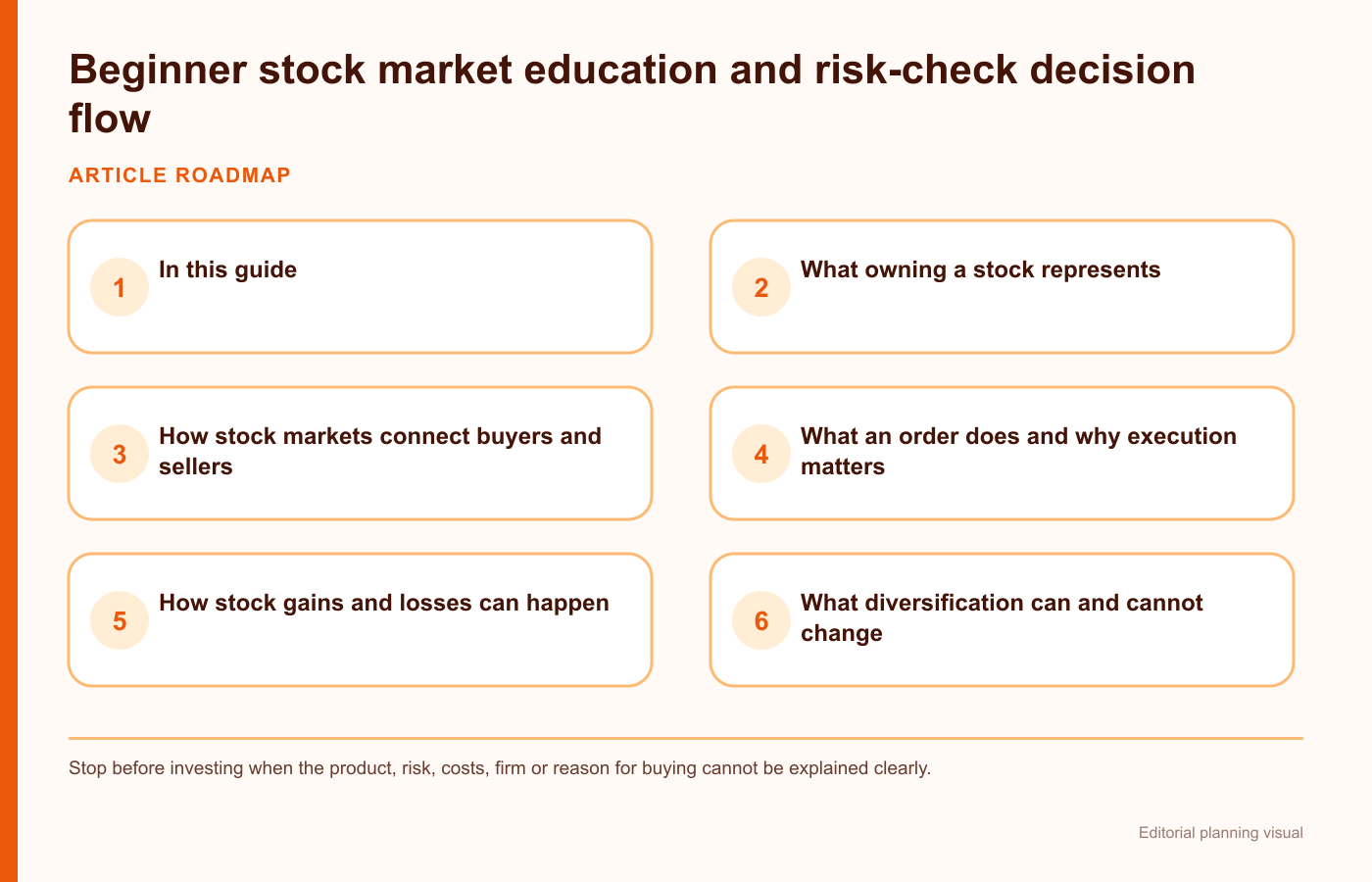
Short answer: a stock is an ownership interest in a company, and stock markets connect buyers and sellers through regulated marketplaces and dealers. A share’s price can rise or fall, income is not guaranteed and a shareholder can lose money. Before considering an investment, understand the product, goal, time horizon, ability to absorb loss, diversification, fees, taxes, order mechanics and registration of the firm or person involved.

Important: this article is education, not personal financial, investment, legal or tax advice. It does not recommend a security, strategy, account, platform or time to invest and does not predict a return.
What owning a stock represents
A share represents a portion of ownership in a company. Shareholders may have rights described by the share class and applicable documents. Some companies may pay dividends, but they are not guaranteed. A company can reduce or stop a dividend, and the market price can fall even when a business remains operating.
Owning one company’s stock differs from owning a fund that holds many securities. A fund also has its own objective, holdings, costs, risks and structure. “Diversified” should not be assumed from a product name. Read current disclosure and ask qualified questions before any decision.
How stock markets connect buyers and sellers
Companies can issue shares to raise capital, while investors trade eligible shares in the secondary market. Exchanges provide marketplaces with listing and trading rules. Investors typically access them through a dealer or platform, not by sending money directly to an exchange.
The quoted price reflects available buy and sell interest at a moment. It can change quickly with company information, economic conditions, interest rates, market sentiment, liquidity and other factors. A recent price is not a promise that an order will execute there or that the price will move in a desired direction.
CIRO’s investing basics explain that choices depend on goals, timeline and willingness and ability to accept risk. Those personal inputs come before product selection.
What an order does and why execution matters
An order tells a dealer or platform that a person wants to buy or sell under specified instructions. A market order generally prioritizes execution rather than a particular price; a limit order specifies a price boundary but may not execute. Exact handling, availability and protections depend on the market, product, account and dealer terms.
Before entering any order, review the security identifier, buy or sell direction, quantity, order type, price instruction, duration, currency, estimated cost and account. Do not use this checklist as a recommendation to trade. Learn with a registered firm or appropriately registered professional and read the current confirmation and statement after any transaction.
| Concept | Question to understand | What is not guaranteed |
|---|---|---|
| Market price | What are buyers and sellers currently offering? | Future price or exact execution |
| Market order | How will execution be prioritized? | A displayed price |
| Limit order | What price boundary and duration apply? | Execution |
| Liquidity | How readily does the security trade? | An easy exit at a desired price |
| Currency | Which currency and conversion cost apply? | A stable exchange rate |
How stock gains and losses can happen
A shareholder may gain if the price rises and the shares are sold for more than total cost, or may receive a dividend. A loss can occur if the price falls, the business performs poorly, the position must be sold at an unfavourable time or costs and taxes reduce the result. In extreme cases, an equity investment can lose most or all of its value.
Risk includes company, sector, market, concentration, volatility, liquidity, currency, behavioural, fraud and time-horizon risk. “Higher potential return” does not mean higher return will occur. CIRO’s material on understanding risk emphasizes the relationship between possible return and possible loss.
What diversification can and cannot change
Diversification spreads exposure across investments, sectors, asset types or regions so one holding has less influence on the whole portfolio. It can reduce certain concentration risks, but it cannot eliminate market loss or guarantee profit. Several holdings can still move together or contain overlapping exposures.
Asset mix and diversification are personal decisions tied to goal, timeline, finances and risk profile. This article does not provide an allocation. A registered adviser can assess suitability where advice is sought; a self-directed investor remains responsible for decisions and research.
Why fees, taxes and account structure matter
Possible costs include commissions, spreads, fund expenses, account fees, advice fees, data charges and currency conversion. The applicable tax treatment can depend on account, transaction, income type and circumstances. Do not rely on a social post or generic example for tax advice.
Ask for current cost disclosure and calculate which costs apply to buying, holding and selling. A “zero commission” label does not mean every cost is zero. Account protections and withdrawal or contribution rules also vary; review current official and provider information.
Use a beginner learning process before any purchase
- Confirm household needs and high-cost obligations are addressed before risking money.
- Write a specific goal and time horizon without assigning an expected return.
- Assess willingness and financial ability to absorb loss as separate questions.
- Learn how the product creates value, loses value, charges costs and can be sold.
- Compare concentration and diversification without assuming either prevents loss.
- Verify the dealer, firm or adviser registration and exact service relationship.
- Learn order mechanics and account terms without using borrowed money or urgency.
- Write a review process based on the goal, not daily price emotion.
CIRO compares DIY and advised investing and tells investors to understand how an investment gains or loses value, its risks, holding period and costs. Neither route guarantees success.
Check registration and investment fraud warning signs
Stop when someone promises guaranteed returns, little or no risk, insider access, urgent action or an exclusive opportunity. Also stop for unsolicited requests for money or personal information, unregistered people or firms, unusual payment methods, unverifiable credentials or pressure to keep the opportunity secret.
CIRO’s fraud warning signs recommend asking questions, researching and checking registration. Verify through the appropriate Canadian registration search using the exact legal name; a website, course or social-media profile is not proof.
Common beginner stock market mistakes
- Buying because of a tip, trend, fear of missing out or promised return
- Investing money needed soon or using borrowed money without understanding risk
- Confusing a share price with company value or affordability
- Ignoring fees, currency conversion and tax questions
- Assuming several similar stocks create meaningful diversification
- Entering an order without understanding execution and confirmation
- Treating education, analysis or signals as personalized advice
- Failing to verify registration of a person or firm
Frequently asked questions
Can a beginner lose all the money invested in a stock?
Yes, an equity position can lose most or all of its value. Risk depends on the security and circumstances, and diversification does not remove all loss risk.
Is a low share price a bargain?
Not necessarily. Price per share alone does not establish company value, quality, risk or future return.
Are stock market courses financial advice?
Education is not automatically personalized advice. Verify registration, service scope and conflicts before relying on anyone for a personal recommendation.
Do limit orders prevent losses?
No. A limit controls an order’s price boundary but may not execute and does not prevent a security from losing value after purchase.