
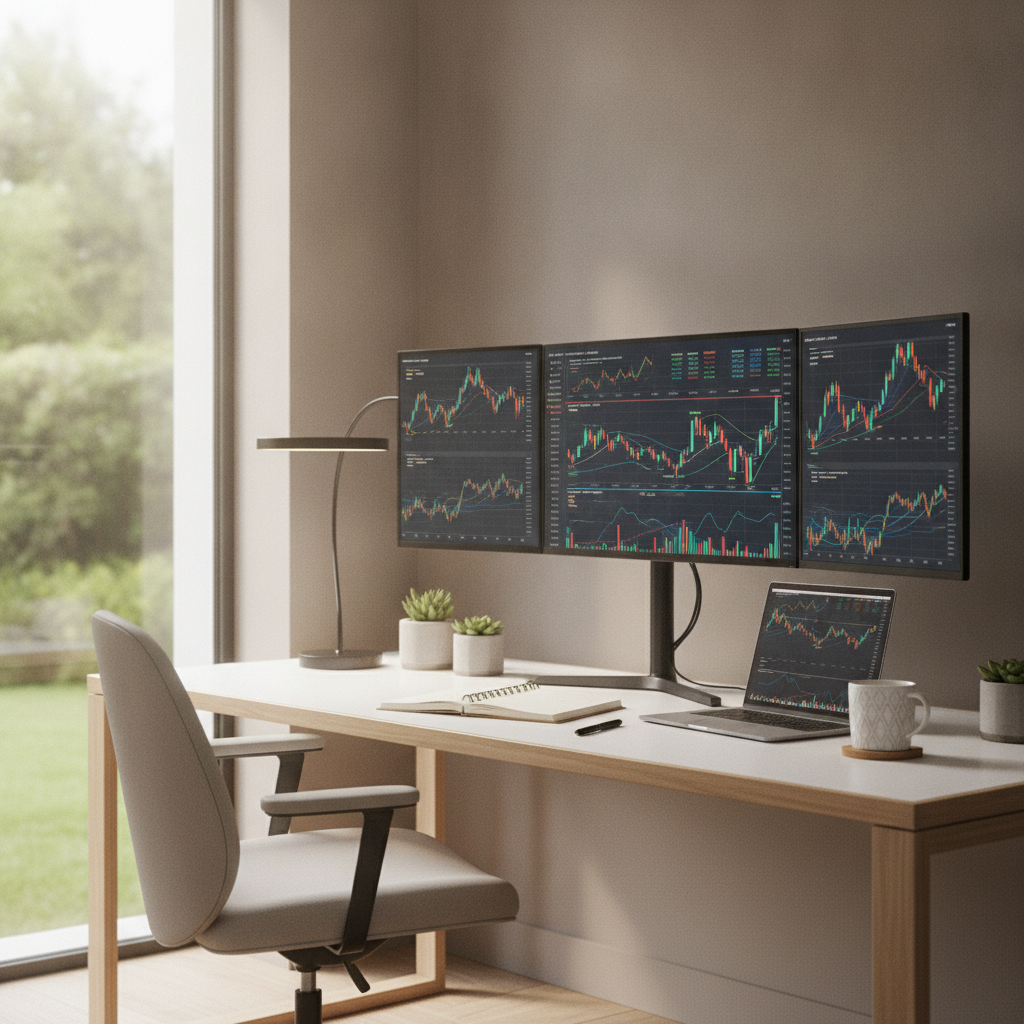
Trading courses for beginners are structured programs that teach market basics, risk controls, and step-by-step execution so you can practice safely before going live. In Canada and beyond, the best beginner paths combine simple lessons, guided drills, and mentorship. The result is a repeatable process that reduces stress and improves consistency.
By Hamed Khan, Proxima Learning • Last updated: 2026-07-04
At a Glance
A great beginner trading course builds foundations, emphasizes risk ≤1% per trade, and turns lessons into practice through simulators, live walkthroughs, and trade journals. Expect 20–30 study hours for core skills and 50–100 simulated trades to build confidence before risking capital.
- What you’ll learn: market structure, order types, entries/exits, risk, psychology
- Formats: self-paced, live cohorts, mentorship, bootcamps
- Tools: charting, real-time news, simulator, journal, curated signals
- Outcome: a simple playbook and a routine you can repeat under pressure
Proxima Learning integrates expert-led lessons, trading signals and alerts, and portfolio context so beginners connect theory to real markets without guesswork.

What Are Beginner Trading Courses?
Beginner trading courses are step-by-step programs that teach how markets work, how to spot quality setups, and how to manage risk with predefined entries, targets, and stop-losses. The best pair clear lessons with live support and simulator reps to build execution skill.
At their core, trading courses for beginners clarify language and structure. You learn order types, time frames, support/resistance, and basic price/volume behavior. You also learn risk math—position sizing, expected value, and why aiming for at least 2:1 reward-to-risk helps durability over a series of trades.
- Foundations: market structure, order flow basics, and mechanics
- Risk-first rules: risk ≤1% per trade; daily max loss to prevent spiral
- Playbook setups: one or two simple patterns to master first
- Practice loop: 50–100 simulator trades to build “muscle memory”
Because Proxima Learning blends technical analysis explained with real-time examples and journal prompts, beginners can progress in days—not months—while avoiding strategy sprawl.
Why Beginner Courses Matter in 2026
The 2026 market is noisy: algorithmic flows, fast headlines, and social chatter. Structured beginner courses filter noise, enforce risk discipline, and prevent common errors like overtrading and chasing moves—so your learning curve is safer and faster.
Here’s the thing: most beginners don’t fail for lack of indicators; they struggle with process. A routine—scan, plan, execute, review—beats ad‑hoc decisions. Simple numbers help: risk ≤1% per trade, aim for 2:1 reward-to-risk, and limit to 1–3 A‑setups. These guardrails protect capital while you learn.
- Information overload: curated modules reduce decision fatigue
- Psychology support: checklists and journaling reduce impulsive entries
- Consistency: repeating the same setup 50+ times builds confidence
- Durability: a max daily loss cap helps you survive rough days
Proxima Learning serves retail traders across Canada and globally with structured learning and beginner-friendly courses focused on clarity, transparency, and accountability.
How Beginner Trading Courses Work
Effective courses cycle through learn → watch → practice → review. You study one concept, see it applied on current charts, practice in a simulator, and get feedback. This loop turns knowledge into repeatable execution under pressure.
Module Flow You Can Trust
- Concept lesson (15–30 min): e.g., trend, support/resistance, or breakouts
- Live demonstration: recent examples on multiple time frames
- Practice reps: 10–20 simulated trades tagged by setup and notes
- Feedback loop: instructor and peer review to correct mistakes
What Proxima Learning Adds
- Expert-led live sessions: real-time Q&A to dissolve confusion
- Actionable trading signals: entries, targets, and stops modeled in real time
- Portfolio perspective: align tactics with long-term goals and risk budgets
- Structured journals: tags for setup, emotion, rule adherence, and outcome
New traders don’t need ten strategies. Start with a bread‑and‑butter setup—such as a pullback to a rising 20‑EMA or a breakout on rising volume—and log 50–100 simulator trades before you scale size. That repetition is what makes execution calm and consistent.
Types of Beginner Trading Courses (Compared)
Four formats dominate: self‑paced, live cohort, mentorship, and bootcamp. Choose based on your schedule, feedback needs, and accountability. Mentored and live options speed corrections; self‑paced maximizes flexibility.
| Format | Interaction | Time Commitment | Accountability | Ideal For |
|---|---|---|---|---|
| Self‑Paced | Low | Flexible, 20–40 hours | Self‑driven | Busy or independent learners |
| Live Cohort | Medium–High | Calendar‑based, weekly | Group accountability | Beginners wanting real‑time feedback |
| Mentorship | High | Customized | 1:1 accountability | Needs tailored guidance |
| Bootcamp | High (intense) | Condensed, multi‑day | Instructor‑led | Fast starters preferring immersion |
- Tip: book 30–60 minutes daily for scans, plans, and reviews.
- Guardrail: cap active strategies at 1–3 until you have 100+ logged trades.
- Milestone: only increase size after four consecutive weeks of rule adherence.
Want a structured path? Explore our online stock trading course or pair learning with stock market signals to see setups unfold in real time.
Buying Guide: How to Choose the Right Beginner Course
Pick a course with a transparent syllabus, credible instructors, risk‑first teaching, and hands‑on practice. Favor programs offering live support, journaling templates, and clear playbooks. Avoid hype; choose process and proof of teaching outcomes.
Non‑Negotiables
- Curriculum clarity: topics, outcomes, and estimated hours listed up front
- Risk protocol: sizing rules, stop placement, and a max daily loss
- Practice + feedback: simulator access and regular trade reviews
- Community + mentorship: access to experienced traders and peers
Due Diligence Checklist
- Review sample modules or an outline to confirm fit
- Ask how live sessions are run and how Q&A is handled
- Confirm tools work with your devices and broker
- Look for proof of learning outcomes (journals, playbooks, routines)
Proxima Learning emphasizes clarity and consistency. Our education pairs with real‑time trading signals and portfolio advisory context so your short‑term tactics align with long‑term plans.
Ready to get organized? Start with our structured path in the beginner trading course guide. You’ll map your routine, pick one setup, and begin journaling your first 50–100 simulator trades.

Best Practices for New Traders
Keep it simple: risk ≤1% per trade, aim for 2:1 reward‑to‑risk, and journal every decision. Standardize a pre‑trade checklist, rehearse entries on a simulator, and review weekly. Consistency beats intensity—small daily reps compound.
Daily Routine (30–60 Minutes)
- Scan: shortlist 3–5 symbols with catalysts or clean patterns
- Plan: define entry, target, and stop before the open
- Execute: take only A‑setups that meet your rules
- Review: tag outcomes, mistakes, and next actions
Risk & Psychology
- Set a max daily loss (e.g., 2–3R) to halt spirals
- Reduce size after two consecutive losses; rebuild with five simulator reps
- Use alerts to avoid screen‑staring and decision fatigue
For deeper chart work, our primer on technical indicators shows how moving averages and volume help define trend, strength, and timing.
Tools and Resources for Beginners
You need four essentials: a reliable charting platform, a real‑time news stream, a trading simulator, and a structured journal. Add curated signals to reinforce your playbook with real‑time examples.
- Charting: draw levels, watch moving averages, track volume surges
- News & calendar: earnings, macro releases, and company updates
- Simulator: practice until your entries feel automatic
- Signals & alerts: study live examples with defined entries, targets, stops
- Journal: tag setups, emotions, and rules to find patterns
Proxima Learning unifies education, trading alerts, and portfolio advisory—so your tools, tactics, and accountability are in one ecosystem.
Case Studies and Practical Examples
Beginners progress fastest when education, signals, and feedback align. The mini‑cases below show how a simple loop—scan, plan, execute, review—turns scattered learning into repeatable results without extra complexity.
Case 1: The Busy Professional
- Constraint: 45 minutes before work
- Plan: one setup (breakout on rising volume), two watchlist names
- Action: set alerts at key levels; execute if conditions match
- Result (6 weeks): fewer impulse trades; steadier execution
Case 2: The Cautious Beginner
- Constraint: fear of loss and overanalyzing
- Plan: micro‑size with 0.5% risk per trade; journal emotions
- Action: 100 simulator reps on one pullback setup
- Result (8 weeks): smoother entries; confidence to go live
Case 3: The Long‑Term Builder
- Constraint: develop trading skill without losing investing focus
- Plan: weekday trading drills; monthly portfolio reviews
- Action: align trades with diversification and risk budgeting
- Result (quarter): better decisions; less stress in volatility
Our guide to stock signals shows how real‑time prompts can serve as learning aids when paired with a disciplined journal.
Frequently Asked Questions
New traders ask about timelines, tools, and risk. Most can learn foundations in 20–30 hours, but skill sticks with practice—plan on 50–100 simulator trades first. Keep risk small, use a journal, and focus on one simple setup.
How long do beginner trading courses usually take?
Most structured paths take 3–6 weeks for core concepts with about 20–30 focused hours. Add 50–100 simulator trades to build comfort before committing real capital.
Do I need advanced math to start trading?
No. Comfort with percentages and basic arithmetic is plenty for risk sizing and position management. Process and discipline matter more than complex equations.
How do trading signals help beginners learn?
Signals provide timely examples with clear entries, targets, and stops. Combined with education and journaling, they speed pattern recognition and reinforce risk rules. Treat them as learning prompts—not shortcuts.
What’s the first setup a beginner should learn?
Pick one clean, rules‑based pattern—like a pullback to a rising moving average or a breakout with volume confirmation. Practice it 50–100 times in a simulator before going live.
Conclusion and Next Steps
Start with clear foundations, one simple setup, and tight risk rules. Commit to daily reps, use a simulator, and track every decision. Education plus signals and mentorship turns knowledge into reliable skill across market cycles.
Key Takeaways
- Trading courses for beginners should be risk‑first and practice‑heavy
- 20–30 study hours + 50–100 simulator trades build confidence
- Limit strategies (1–3) until you have 100+ logged trades
- Journaling is a force multiplier for learning speed
Action Steps
- Explore our beginner trading course guide
- Pair learning with real‑time alerts
- Set a 30–60 minute daily practice block and start journaling today
If you want a calm, consistent path, we’re here to help you learn, trade, and grow with confidence.