

A provider-neutral course comparison guide
Compare Stock Market Courses Before You Enrol
Short answer. Compare stock market education courses by the decision you want to make after learning—not by return claims or lifestyle marketing. Check the curriculum sequence, prerequisites, instructor identity, conflicts, practice method, feedback, total cost, refund terms and risk disclosures. Ask for a sample lesson and written terms. Education can improve understanding and process, but it cannot remove market risk, guarantee profit or determine whether an investment is suitable for you.

Compare the learning objective, curriculum, instructor transparency, practice method, total cost and risk disclosures before enrolling.
Define what the course must help you understand
“Learn the stock market” is too broad to compare courses. Decide whether you need market foundations, account and order mechanics, financial statements, portfolio construction concepts, risk management, technical-analysis literacy, research process or an explanation of how advice differs from do-it-yourself investing. Write down what you should be able to explain or demonstrate at the end.
Separate education from advice. A course can explain concepts and methods. Personalized investment advice considers an individual’s circumstances and may engage regulatory obligations. A course should not quietly turn into security recommendations, signals or pressure to fund an account. The CIRO comparison of DIY and advised investing is useful background because it describes different responsibilities, services and costs without declaring one path right for everyone.
Also assess your starting point. A beginner may need terminology, market structure, diversification and risk before strategy. An experienced learner may need a narrow method, data practice and critical review. A mismatch can make a well-produced course unhelpful.
Compare four common education formats
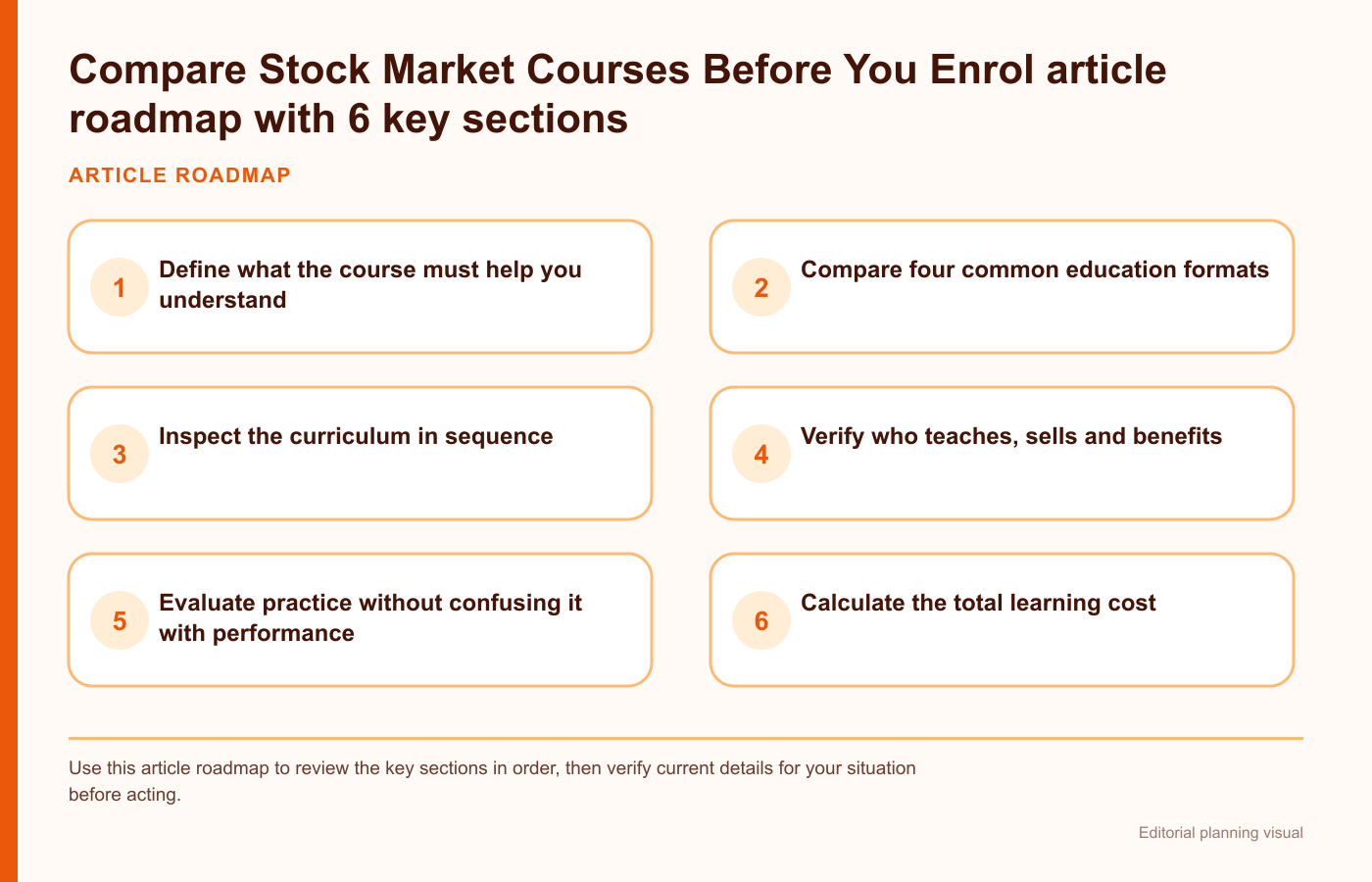
Use this article roadmap to review the key sections in order, then verify current details for your situation before acting.
| Format | Potential fit | Trade-offs to inspect |
|---|---|---|
| Self-paced foundations | Learners needing flexible scheduling and a structured introduction | Limited feedback, unclear completion support, content may become dated |
| Live cohort course | Learners who benefit from deadlines, discussion and questions | Fixed schedule, group pace, recordings and instructor access may vary |
| Strategy-specific workshop | Learners with prerequisites who want to examine one method critically | Narrow scope, risk of marketing a technique without market context or limitations |
| Practice lab or mentorship | Learners who need feedback on research and decision process | Higher time or cost, possible conflicts, unclear boundary between education and advice |
Delivery format is not evidence of quality. A live class can still lack a coherent curriculum, and a self-paced course can be rigorous. Compare the learning design, evidence and terms inside the format.
Inspect the curriculum in sequence
Ask for module titles, lesson objectives, prerequisites, exercises and assessment method. A credible beginner sequence normally explains risk and uncertainty early, before presenting complex tools. It distinguishes historical data, simulation and live outcomes. It should show how assumptions, fees, taxes, liquidity and behaviour can affect decisions without pretending that a checklist predicts performance.
Use these curriculum questions:
- Does each module state what the learner will be able to explain or do?
- Are prerequisites explicit, or does the course jump from vocabulary to advanced tactics?
- Are risk, diversification, costs and limitations integrated throughout?
- Are examples dated and sourced so learners know the market context?
- Does the course distinguish research from prediction and education from advice?
- Are assessments based on reasoning and process rather than profit?
- Is there a policy for material updates when rules, platforms or market structure change?
Avoid judging a curriculum by hours alone. Ten focused hours with exercises and feedback may be more useful than a large video library with repetition and no progression.
Verify who teaches, sells and benefits
Confirm the legal provider name, instructor identity, relevant experience, role and contact channel. Ask which statements can be verified independently. Credentials should be specific and current; vague labels such as “expert,” “professional” or “successful trader” are not enough.
Check conflicts. Does the provider receive affiliate compensation from a broker, software platform, data service or another course? Does a free class lead to a high-pressure upsell? Are testimonials typical, selected or independently verifiable? Is the instructor trading or promoting an asset discussed in the lesson? Written disclosure helps you evaluate the information; it does not automatically make the course suitable.
CIRO’s guidance on finfluencers and investing advises people to examine qualifications, conflicts, promises and online investment information carefully. If a person or firm offers investment advice, sells investments or performs another regulated activity, verify the applicable registration and scope through official sources. Education alone and regulated advice are not interchangeable categories.
For business-specific details, review Proxima Learning’s current about information and services page, then request written confirmation of instructors, curriculum, delivery and terms. This guide does not assert that any particular course or instructor is currently available.
Evaluate practice without confusing it with performance
Practice should reveal whether the learner can apply a process: define a question, find information, document assumptions, identify risk, compare alternatives and explain a decision. Simulated exercises can help because mistakes do not require putting capital at risk. They have important limits: fills, liquidity, emotion, taxes, fees and market impact may differ from live conditions.
Ask how feedback is delivered. Is it tied to a rubric? Can learners see why an answer is incomplete? Does the reviewer challenge confirmation bias and unsupported certainty? Are practice records private? Avoid programs that treat a short simulated gain, screenshot or selected trade as proof that a method works.
Never send money, cryptocurrency, account credentials, one-time codes or remote-device access to participate in a lesson. A legitimate educational exercise can use public or fictional data without taking control of a learner’s financial account.
Calculate the total learning cost
The advertised tuition may exclude taxes, data subscriptions, software, books, certification fees, community access, renewal charges or advanced modules. Ask for a complete written price and identify recurring costs. Read cancellation, refund, transfer and access-expiry terms before paying.
Value cannot be calculated from a promised return. Compare what is actually delivered: curriculum depth, exercises, qualified feedback, update policy, accessibility, support response and duration of access. If a provider will not explain the product until after payment, the information gap is itself a decision factor.
| Cost question | What to confirm in writing |
|---|---|
| Tuition | Full amount, tax, deposit and payment schedule |
| Tools | Required data, software, brokerage or device costs |
| Access | Start date, expiry, recordings, updates and download rights |
| Support | Format, frequency, response time and any limits |
| Exit | Cancellation, refund, transfer and deferral terms |
Recognize course and promotion warning signs
- Guaranteed returns, “risk-free” claims or claims that losses can be eliminated
- Pressure to act immediately because a price or opportunity will disappear
- Unverifiable profit screenshots, luxury imagery or testimonials replacing curriculum detail
- Instructions to copy trades, join signal groups or buy an asset without risk analysis
- Undisclosed broker, platform, course or asset-promotion conflicts
- Requests for account credentials, remote access, cryptocurrency transfers or payment to an individual
- An instructor identity, business address or refund policy that cannot be verified
The Ontario Securities Commission’s investor alerts are one place to check current warnings. Absence from an alert list is not proof that a course or opportunity is legitimate.
Use a decision scorecard, not a provider ranking
Score each course from zero to two on evidence you can verify: zero for absent, one for partial and two for clear. Use categories such as learning-objective fit, prerequisites, curriculum sequence, instructor transparency, conflict disclosure, risk treatment, practice quality, feedback, full cost and exit terms. Add notes and source links beside every score.
Do not total the numbers automatically. Some are gates. A high-production course with return guarantees or unclear provider identity should not be rescued by strong scores elsewhere. Identify your non-negotiables before speaking with a salesperson.
Request a sample lesson, syllabus and written agreement. Wait long enough to review them without pressure. Compare at least two formats that could meet the same objective. If neither provides adequate evidence, choosing no course yet is a valid outcome.
Common mistakes when choosing a stock market course
Choosing by income promise
Markets are uncertain. Evaluate education quality and risk disclosure, not promised performance.
Skipping foundational knowledge
Advanced vocabulary does not replace understanding of diversification, costs, orders and loss risk.
Ignoring conflicts and upsells
Ask how every instructor, affiliate and platform relationship is compensated.
Equating simulation with live results
Use simulation to practise process, not to predict future returns.
Paying before reading terms
Confirm total cost, access, support, cancellations and refunds in writing.
Frequently asked questions
Can a stock market course guarantee better returns?
No. Education may improve knowledge and decision discipline, but no course can guarantee returns or eliminate the risk of loss.
Is a live course better than self-paced learning?
Not universally. Live formats may offer feedback and accountability; self-paced formats may offer flexibility. Curriculum and evidence matter more than delivery alone.
Does an investment educator need to be registered?
It depends on the activities performed and the jurisdiction. General education is different from providing advice, selling securities or other regulated activity. Verify registration and permitted scope when those services are offered.
Should beginners trade real money during a course?
A beginner can learn concepts and practise a documented process without risking capital. Simulation also has limits and should not be presented as predictive performance.
Request the evidence needed for a fair comparison
Use the criteria above to request a current syllabus, instructor details, sample lesson, total price, conflicts, risk disclosures and refund terms. Browse Proxima Learning’s educational posts for public context and use its contact route to confirm the exact offering. Treat the response as information for comparison, not as a promise of investment performance.